INTRODUCTION
The introduction of combined antiretroviral therapy (ART) at the end of the1990s led to reduced acquired immune deficiency syndrome (AIDS) mortality rates because it remarkably reduced the incidence of AIDS-related diseases. However, the occurrence of adverse actions from ART use, especially those related to its long-term, contributes to give HIV infection chronic characteristics. Among the main adverse reactions related to long-term ART are included lipodystrophy syndrome; a clinical condition characterized by abnormal redistribution of body fat, including accumulation of fat in the abdomen, trunk, and neck (lipohypertrophy); loss of fat in the face, arms, legs, and buttocks (lipoatrophy); or its mixed form as well as metabolic alterations (lipodystrophy).1 The absence of adequate diagnostic criteria for fat distribution abnormalities is the main problem that limits the definition of the lipodystrophy, which depends on the patient's description based on his self-perception and subsequent confirmation by health care provider.2,3
The pathogenesis of lipodystrophy remains unclear; however, there is evidence suggesting a multifactorial pathogenic mechanism. Among the causes are included individual characteristics, HIV infection and the type/duration to ART as main factor. The lipohypertrophy is more common among women, while lipoatrophy is more commonly observed in men. Older age, increased triglyceride levels and a lower nadir CD4+ cell count are also associated with lipoatrophy. Combination therapy based on the use of nucleoside analogue reverse-transcriptase inhibitors (NTRI), mainly stavudine (d4T) or zidovudine (ZDV) and a protease inhibitor (PI) are associated with lipoatrophy.4,5 However, ritonavir use could mitigate the negative effect of lipodystrophy, which justifies the preference for PI-regimens with boosted of ritonavir. 6
Recently, the use of d4T was phased out of the first-line ART worldwide, whereas the use of ZDV was restricted to alternative or second line antiretroviral regimens in most countries in order to reduce the risk of lipoatrophy in HIV patients. Nevertheless, until 2013 approximately 53% of patients on treatment in Latin American and Caribbean were still receiving ART containing ZDV.7 Owing to the need of initiating ART earlier as recommended by current evidences8, 9 and the need of lifelong ART, HIV-infected patients will be continuously at risk of developing lipodystrophy.
Studies based on clinical diagnosis shows high prevalence of lipodystrophy, more than 30%.10-12 The lipodystrophy is associated with a negative psychosocial impact, which contributes to poor adherence to ART and decreased quality of life. Many patients develop low self-esteem, anxiety, depression and even social isolation.13 In addition, this outcome creates new demands on the services responsible for comprehensive patient care. The present work aimed at estimating the incidence of lipodystrophy in a cohort of HIV patients initiating ART between 2001 and 2005 and followed-up for up to five years and to investigate factors associated with its occurrence.
METHODS
Study design and population
A historical cohort study of adult HIV/AIDS patients who began ART between 2001 and 2005 was carried out in three referral public centers for HIV/AIDS treatment and monitoring in Belo Horizonte, State of Minas Gerais, Brazil and neighbouring municipalities - "Centro de Treinamento e Referência em Doenças Infectoparasitárias - CTR/DIP Orestes Diniz, Hospital Eduardo de Menezes - HEM/Fundaçao Hospitalar de Minas Gerais - FHEMIG e do Centro de Aconselhamento e Testagem Sagrada Família da Secretaria Municipal de Saúde de Belo Horizonte - SMSA/BH". Patients were followed for at least one year (maximum follow-up, 5 years). Information regarding the outcomes and the exposure variables were collected from the patients' medical records between November 2012 and September 2013.
The sample size was estimated based on the total of HIV/AIDS patients who started antiretroviral therapy in the tree treatment centers during the study period (n=1.631). Patients eligible for study comprised HIV/AIDS patients i) aged 18 years or older at the baseline, ii) initiating first ART between 2001 and 2005, iii) undergoing ≥ 12 months of follow-up by the HIV/AIDS referral center. Further cohort procedures and eligibility criteria have been described and published elsewhere.14
Outcome and exposure variables
All collected data were strictly considered as recorded in medical charts. Lipodystrophy was the outcome measured by the record of the occurrence of lipodystrophy and the related phenotypes - lipohypertrophy and lipoatrophy or mixed lipodystrophy within five years after the first ART prescription. For clinical classification and recording, lipohypertrophy definition could include abnormal fat accumulation characterized by abdominal obesity, an increase in the thoracic perimeter, breast hypertrophy, increased lateral neck fat, increased dorsal neck fat, and localized or generalized lipomas. Lipoatrophy was considered as the loss of fat in the face, buttocks, and extremities. Mixed lipodystrophy was defined as the simultaneous occurrence of both phenotypes (lipohypertrophy and lipoatrophy).15 When ever only the term "lipodystrophy" was recorded by the physician without specification of the phenotypes, the patient was classified as having "non-specified lipodystrophy."
Potential explanatory variables were collected at the baseline (socio-demographic, clinics, initial ART) and at the follow-up period (ART switching, irregular use of ART, number of medical visits per year and number of hospitalization). Irregular use of ART was considered in this study as any record of the physician that could indicate irregularity in the antiretroviral treatment (e.g. missed doses, abandon and non-adherence). ART switch was defined as at least one drug alteration in triple combined ART regimen, or the addition of antiretroviral drugs to monotherapy or dual therapy with ZDV. The variable medical consultation was dichotomized considering the average of medical visits per year (<4 and ≥ 4), in accordance with guidelines.16
Data analysis
A descriptive analysis was performed to characterize the population regarding the outcome and exposure variables. Measures of central tendency and dispersion were used for continuous variables and absolute and relative frequencies for categorical variables. Cumulative and person-time incidence rates of lipodystrophy were estimated. The numerator of the person-time incidence rate was the number of patients with at least one record of lipodystrophy. The denominator was the sum of the times, in months, free of the outcome contributed for each participant, corresponding to i) the time between the first ART prescription and the first record of lipodystrophy; and, ii) the time between the first ART prescription and the last consultation for those without the outcome.
Logistic regression method was employed for univariate and multivariate analyses. Patients with lipodystrophy (lipoatrophy, lipodystrophy or nonspecified lipodystrophy) were compared with those without the outcome regarding selected exposure variables. The strength of the associations was estimated through the odds ratios (OR) with 95% confidence intervals. Variables included in the initial multivariate model were those associated with lipodystrophy in the univariate analysis (p≤0.20). Modeling started with all variables followed by sequential deletion to assess the statistical significance of each one, remaining in the final model only those with a p-value≤0.05. Likelihood ratio test was used to compare models and the goodness-of-fit of was assessed by Hosmer-Lemeshow test.
The Questionnaire Development System (QDS - version 2.6.1) and the Statistical Analysis System (SAS - version 9.4) were used for data collection and analysis, respectively.
Ethics
The study was approved by the ethics committee of the Universidade Federal de Minas Gerais (CAAE 0017.0.438.203.11) and of the participating centres, (Parecer 11/05/2010 - HEM/FHEMIG and Parecer 0017.0.438.438.11A - SMSA/BH).
RESULTS
Lipodystrophy occurrence
A total of 247 patients met the study eligibility criteria. Of these, 17 (6.9%) patients had records on lipodystrophies during the follow-up period, corresponding to an incidence rate of 0.15 case/100 person-months. The medical diagnoses of lipohypertrophy, lipoatrophy, and non-specified lipodystrophy were documented for four (1.6%), six (2.4%), and 12 (4.9%) patients, respectively. For five patients, non-specified lipodystrophy and lipoatrophy or lipohypertrophy, were recorded simultaneously. Fat accumulation occurred in the form of abdominal visceral fat (n=1), lipomas (n=2), and non-specified body localization (n=1). Loss of fat in the patients occurred in the face (n=4), legs (n=1), and legs and face (n=1).
The median times (±SD - standard deviation) from the first ART up to the outcome occurrence were 31.9±13.2, 33.4±17.2 and 34.0±17.6 for non-specified lipodystrophy, lipoatrophy and lipohypertrophy, respectively.
Description of population characteristics
The main baseline and follow-up variables are presented in Table 1. Approximately half of the patients was older than 35 years (mean ± SD; 36.7 ± 9.9 years) and 60% were male. A relatively high number of patients had at least one AIDS-related disease and the majority had a CD4 count lower than 200 cells/mm3 at baseline (mean ± SD; 193.7 ± 143.1). The mean (±SD) of the triglycerides was 154 ± 91 mg/dl.

Most patients initiated ART including regimens with two NRTI and one NNRTI (55.9%). Among the NRTI class predominated the regimen with zidovudine (ZDV) plus lamivudine (3TC) (83.2%), the NNRTI predominated efavirenz (EFZ) and PI predominated nelfinavir (NFV) (63.3%). Approximately 60% of the patients had a follow-up period longer than 48 months (61.5%; mean ± SD; 48.4 ± 14.1).
A relatively high proportion of patients switched ART at least once and used ART irregularly. Most recorded reasons for switching comprised adverse drug reactions and drug failure. Eleven out of the 17 lipodystrophy cases had at least one ART switching. Three patients modified d4T- to tenofovir (TDF)-based regimens to improve lipodystrophy. Four patients had ART switched due to other adverse drug reactions or ART failure and for four patients the reasons were not recorded. Reasons for irregular ART use were poorly documented. Forgetfulness, non-specified adverse drug reactions, drug failure, alcohol use and lack of antiretroviral drugs at the public pharmacy were some of the reasons recorded for missed doses.
Only 24 (9.7%) patients had an average of four or more medical consultations per year. A large proportion of information on anthropometric data was missing. Body weight and height were documented, respectively, only for 193 and 48 participants, yielding a body mass index (BMI) mean of 22.5±3.0. Three out 48 patients were underweight and 10 (20.8%) were overweight at the baseline.
Univariate and multivariate analysis
Table 2 presents the results of the univariate analysis. Age, HIV/AIDS-related disease medical consultation, ART switch and irregular use of ART were statistically associated with lipodystrophy (p≤0.20).

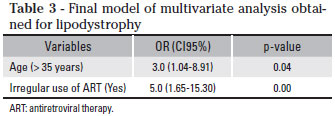
Patients older than 35 years and irregular use of ART were independently associated with lipodystrophy (Table 3). Goodness-of-fit of the final model was satisfactory (Hosmer-Lemeshow test =1.52; p=0.47).
DISCUSSION
Our study reported the occurrence of lipodystrophy in a cohort of naïve-treatment HIV-infected patients initiating ART between 2001 and 2005 and followed-up up to five years. The absence of adequate diagnostic criteria for lipodystrophy mainly in mild to moderate cases is a problem in the estimation of the incidence of this adverse drug reaction. In the literature, the incidence ranges from 8%-49%.17-19 We found a lower incidence (≈7%), despite the quite long period of follow-up. This discrepancy might be due to the analysed medical record data, which may have underestimated the occurrence of lipodystrophy, particularly that of the mixed form. In Brazil the diagnosis of lipodystrophy through more sophisticates techniques such as nuclear magnetic resonance -NMR, dual-energy x-ray and absorptiometry - DEXA, has not been routinely and obligatory performed in public HIV/AIDS referral centres,20 althoughthe use of such methods might not bring any additional benefits for the diagnosis.21 Based on the patient's self-report and/or on clinical examination by physician the ascertainment of mild to moderate cases of lipodystrophy might have been underestimated.
Lipodystrophy occurred regardless of the type of ART (NNRTI vs. PI). ZDV and d4T, considered as the main drugs inducing lipodystrophy, was included in all prescribed antiretroviral regimens. Three ART switches were clearly recorded to manage lipodystrophy, strengthening the association found. Of note, the recommendations of the Brazilian Ministry of Health for the initial ART during the period between 2001 and 2003 placed d4T as the first or second choice of NRTI combined with lamivudine (3TC) or ddI (didanosine), respectively. Starting in 2004, the consensus in Brazil was to consider d4T combined with 3TC as the second choice drug for patients intolerant to ZDV due to high drug toxicity.22 Moreover, PIs were considered quite frequently as NNRTIs in the antiretroviral regimen, which is also explained by the recommendations and the provision of the drugs by the national AIDS program between 2001 and 2003.
Our data showed that most patients had late ART initiation (≈63%; data not shown) - indicated by the high proportion of patients with low CD4 counts (58.1%) or by the presence of at least one AIDS-related diagnosis at the baseline (37.5%). Current evidence has demonstrated that early ART contributes for a better disease prognosis.8, 9 Nevertheless, early initiation, along with the need of long-term ART, will expose HIV-infected patients to longer treatment and thus increase the risk of lipodystrophy. On the other hand, patients receiving first ART in the later stage of the disease will be also at higher risk of developing lipodystrophy. HIV infection itself could have played a role in explaining the higher proportion of lipodystrophy among the patients with later stages of the disease.4,5
The results of univariate analysis demonstrated that patients who had higher number of medical consultations per year were also a risk factor for lipodystrophy. Lipodystrophy may add to the complexity of the treatment of patients, especially those with delayed ART initiation and advanced stages of infection,23 making these seek care more frequently.
Irregular use of ART was employed in the study in a broader way, considered as any medical record indicating irregularity in the ART use (e.g. missed doses). Our study demonstrated a positive significant association between lipodystrophy and irregular use of ART. However, as we were not able to precisely establish the reasons for irregular use, this finding should be interpreted with caution. Age was independently associated with lipodystrophy, which corroborate the results of other studies.5
Possible limitations of this study include the use of secondary data, which may have underestimated the incidence of lipodystrophy. Additionally, the poor medical documentation of key variables such as viral load, anthropometric data and those concerning ART (irregular use/non-adherence, switching) was a drawback. Despite this, our longitudinal analysis demonstrated that lipodystrophy will occur after ART use (≈30th month), especially among patients older than 35 years and those with irregular use of ART. Our findings should contribute to raising awareness on the need of adequate record of patient's data in medical charts. These can be useful source for pharmaco vigilance of adverse events in the field of HIV/AIDS.
The lipodystrophy is a rare disease in the general population, but is a usual adverse reaction in HIV/AIDS patients. Although lipodystrophy is not a life-threatening adverse drug reaction, it can lead to important clinical and psychosocial consequences (e.g. cardiovascular diseases, ART adherence, and depression),24,25 which deserve particular attention from health professionals who care for patients with HIV/AIDS.
CONCLUSION
Lipodystrophy is a clinical condition/adverse drug reaction poorly recorded in medical charts. Lipodystrophy should be monitored among people living with HIV/AIDS on long-term ART, especially those older than 35 years and using ART irregularly.
ACKNOWLEDGMENTS
The authors would like to thank the public health centers for HIV/AIDS treatment and monitoring in Belo Horizonte: "Centro de Treinamento e Referência em Doenças Infectoparasitárias - CTR/DIP Orestes Diniz, Hospital Eduardo de Menezes - HEM/Fundaçao Hospitalar de Minas Gerais - FHEMIG, and Centro de Aconselhamento e Testagem Sagrada Família da Secretaria Municipal de Saúde de Belo Horizonte - SMSA/BH for the access to patients' charts, enabling the study conduction.
The authors are also grateful to Fundaçao de Amparo à Pesquisa do Estado de Minas Gerais - FAPEMIG (nº APQ0043-10), Conselho Nacional de Desenvolvimento Científico e Tecnológico - CNPq (nº 484865/20110) and Pró-Reitoria de Pesquisa PRPq/UFMG for the financial assistance.
REFERENCES
1. Barbaro G, Iacobellis G. Metabolic syndrome associated with HIV and highly active antiretroviral therapy. Curr Diab Rep. 2009; 9(1):37-42.
2. Domingo P, Estrada V, Lopez-Aldeguer J, Villaroya F, Martinez E. Fat redistribution syndromes associated with HIV-1 infection and combination antiretroviral therapy. AIDS Rev. 2012; 14(2):112-23.
3. Lana LG, Junqueira DR, Perini E, Menezes de Padua C. Lipodystrophy among patients with HIV infection on antiretroviral therapy: a systematic review protocol. BMJ Open. 2014; 4(3):e004088.
4. Chen D, Misra A, Garg A. Clinical review 153: lipodystrophy in human immunodeficiency virus-infected patients. J Clin Endocrinol Metab. 2002; 87(11):4845-56.
5. Seminari E, Tinelli C, Minoli L, Sacchi P, Filice G, Zocchetti C, et al. Evaluation of the risk factors associated with lipodystrophy development in a cohort of HIV-positive patients. Antivir Ther. 2002; 7(3):175-80.
6. McComsey G, Rightmire A, Wirtz V, Yang R, Mathew M, McGrath D. Changes in body composition with ritonavir-boosted and unboosted atazanavir treatment in combination with Lamivudine and Stavudine: a 96-week randomized, controlled study. Clin Infect Dis. 2009; 48(9):1323-6.
7. World Health Organization - WHO. Antiretroviral treatment in the spotlight: a public health analysis in Latin America and the Caribbean. Genova: WHO; 2014.
8. Insight Start Study Group, Lundgren JD, Babiker AG, Gordin F, Emery S, Grund B, et al. Initiation of Antiretroviral Therapy in Early Asymptomatic HIV Infection. N Engl J Med. 2015; 373(9):795-807.
9. Grinsztejn B, Hosseinipour MC, Ribaudo HJ, Swindells S, Eron J, Chen YQ, et al. Effects of early versus delayed initiation of antiretroviral treatment on clinical outcomes of HIV-1 infection: results from the phase 3 HPTN 052 randomised controlled trial. Lancet Infect Dis. 2014; 14(4):281-90.
10. Nguyen A, Calmy A, Schiffer V, Bernasconi E, Battegay M, Opravil M, et al. Lipodystrophy and weight changes: data from the Swiss HIV Cohort Study, 2000-2006. HIV Med. 2008; 9(3):142-50.
11. Cabrero E, Griffa L, Burgos A. Prevalence and impact of body physical changes in HIV patients treated with highly active antiretroviral therapy: results from a study on patient and physician perceptions. AIDS Patient Care STDS. 2010; 24(1):5-13.
12. Diehl LA, Dias JR, Paes AC, Thomazini MC, Garcia LR, Cinagawa E, et al. Prevalência da lipodistrofia associada ao HIV em pacientes ambulatoriais brasileiros: relaçao com síndrome metabólica e fatores de risco cardiovascular. Arq Bras Endocrinol Metabol. 2008; 52(4):658-67.
13. Shenoy A, Ramapuram JT, Unnikrishan B, Achappa B, Madi D, Rao S, et al. Effect of lipodystrophy on the quality of life among people living with HIV (PLHIV) on highly active antiretroviral therapy. J Int Assoc Provid AIDS Care. 2014; 13(5):471-5.
14. Menezes de Pádua CA, Moura CS. Availability of data on adverse reactions to antiretroviral drugs in medical charts according to the naranjo algorithm: an example of a brazilian historical cohort. Clin Drug Invest. 2014; 34(6):395-402.
15. Carr A. Improvement of the study, analysis, and reporting of adverse events associated with antiretroviral therapy. Lancet. 2002; 360(9326):81-5.
16. Nemes MIB, Caraciolo JMM, Santos MA, Alves AM, Yokaichiya CM, Prado RR, et al. Avaliaçao da qualidade dos serviços ambulatoriais do SUS que assistem adultos vivendo com HIV/Aids no Brasil. [Citado em 2016 abr. 18]. Disponível em: http://www.aids.gov.br/sites/default/files/anexos/publicacao/2012/52013/relat_rio_final_qualiaids_2010_11614.pdf.
17. Capiluppi B, Ciuffreda D, Sciandra M, Marroni M, Tambussi G, Lazzarin A. Metabolic disorders in a cohort of patients treated with highly aggressive antiretroviral therapies during primary HIV-1 infection. AIDS. 2000; 14(12):1861-2.
18. Bogner JR, Vielhauer V, Beckmann RA, Michl G, Wille L, Salzberger B, et al. Stavudine versus zidovudine and the development of lipodystrophy. J Acquir Immune Defic Syndr. 2001; 27(3):237-44.
19. Goujard C, Boufassa F, Deveau C, Laskri D, Meyer L. Incidence of clinical lipodystrophy in HIV-infected patients treated during primary infection. AIDS. 2001; 15(2):282-4.
20. Ministério da Saúde (BR). Síndrome lipodistrófica em HIV. 2011. [Citado em 2016 nov. 05]. Disponível em: http://www.aids.gov.br/sites/default/files/anexos/publicacao/2011/50427/vers_o_final_63134.pdf.
21. Carr A. HIV lipodystrophy: risk factors, pathogenesis, diagnosis and management. AIDS. 2003; 17(Suppl 1):S141-8.
22. Ministério da Saúde (BR). Recomendaçoes para terapia antirretroviral em adultos e adolescentes infectados pelo HIV. 2003. [Citado em 2016 mar. 22]. Disponível em: http://www.giv.org.br/publicacoes/consenso_2004.pdf
23. Acurcio FA, Cesar CC, Guimaraes MD. Health care utilization and survival among patients with AIDS in Belo Horizonte, Minas Gerais, Brazil. Cad Saúde Pública. 1998; 14(4):811-20.
24. Jantarapakde J, Phanuphak N, Chaturawit C, Pengnonyang S, Mathajittiphan P, Takamtha P, et al. Prevalence of metabolic syndrome among antiretroviral-naive and antiretroviral-experienced HIV-1 infected Thai adults. AIDS Patient Care STDS. 2014; 28(7):331-40.
25. Verolet CM, Delhumeau-Cartier C, Sartori M, Toma S, Zawadynski S, Becker M, et al. Lipodystrophy among HIV-infected patients: a cross-sectional study on impact on quality of life and mental health disorders. AIDS Res Ther. 2015; 12:21.