INTRODUCTION
Infectious diseases are a field of medicine that arouses interest because involves a complex interaction between humans and infectious agent which may or may not result in disease. The diagnosis and proper treatment is critical to the effectiveness of treatment and patient survival. In this context, the Acquired Immune Deficiency Syndrome (AIDS) is presented as one of the most important diseases, not only for its prevalence, but by systemic involvement.
The Centers for Disease Control and Prevention (CDC) reported the first AIDS case in 1981, in the United States1 and in 1983 the etiologic agent was identified - the Human Immunodeficiency Virus (HIV).2
HIV replication is massive at any stage of infection, being that ten billion viral strains are produced and eliminated daily in an infected person.2,3 The ongoing battle between viruses and the immune system hinders the restoration of immune cells. The immune deficiency characterizes the onset of AIDS, and favours opportunistic tumors and infections.
The detection of the immunodeficiency and evaluation of the immunological condition is made by symptomatology, the lymphocyte T CD4+ count and viral copies in peripheral blood. To estimate the prognosis and define the start of antiretroviral therapy is monitored the evolution of lymphocyte T CD4+ count - marker of the immune status of individuals - and plasma quantification of HIV viral load - marker of the risk of subsequent decline in T CD4+ counts.4
The T CD4+ cell count also allows the identification of episodes of infections for which the carriers of the virus and the syndrome are exposed - at counts above 350 cells/mm3, the most common infectious episodes are bacterial and if the immunodeficiency progress atypical presentations of the infection may occour while in counts between 200 and 300 cells/mm3 are most common the fungal and atypical germs infections, such as Pneumocystis carinii.5
Despite the possibility to quantify the risk of disease progression according to blood levels of CD4 and viral load, early diagnosis of HIV infection is critical to the prognosis, because it allows early antiretroviral therapy and to provide guidance about techniques to reduce the risks of transmission in the most appropriate moment.
The importance of early diagnosis is evident when studies show that, after the diagnosis of seropositivity is often the CD4 count found below 200/mm3 and about 40% of people develop AIDS within one year after the confirmation of the presence of HIV.6-8
The aim of this work is, based on the comparison of clinical markers, serologic and virologic of HIV infection, show its usefulness in early diagnosis of AIDS.
METHODS
This study compared clinical markers, serologic and virologic of HIV infection in a cross-sectional observational study, carried out according to the rules and regulated guidelines for research involving human beings of Resolution CNS 196/96 of the Ministry of Health. It was approved by the Ministry of Health, as the General Certificate for Ethics Assessment (CAAE) - number 13676313.3.0000.5156.
The study was performed at the Counseling and Testing Center for sexually transmissible diseases (CTA) in the city of Barbacena-MG. The sampling was made up of the medical records of patients attended with HIV/AIDS in this center, in a total of 154 records.
The study consisted in the identification of the data in the medical records and in the transfer of the variables to a proper form. Patients were described according to: year of the first consultation, sex, age, race, marital status, type of sexual partners, possibility of blood infection by blood transmission, CD4 counts and viral load before the initiation of antiretroviral treatment, clinical presentation recorded by the doctor, presence of medical condition not related to AIDS, the date of initiation of treatment with antiretroviral, CD4 count and viral load and case definition criteria.
Patients were stratified, in groups, according to the CD4 count (categories: 0-200, 201-350, 351-500, 501-750 and above 750/mm3) and viral load (categories: less than 500, 500-3.000, 3.000-10.000, 10.000-30.000 and above 30.000/mm3).
The AIDS case definition criteria used in the CTA are the CDC criteria and Critério Rio de Janeiro/Caracas, which allowed the qualification of patients who sought the CTA with the established disease.
It was determined, also, the frequency of viral load strata and linfometria CD4 prior to antiretroviral treatment, discriminated by CDC criteria and Rio de Janeiro/Caracas, by the confirmed HIV diagnosis and by the symptomatology, present or not.
The analysis of data, fulfilled on computers, using statistical processing resources of software Stata 9.2. Frequency distributions were constructed, calculated mean, median, standard deviation and appropriate percentage for each variable. Comparisons between variables were described in the text or shown in RXC type contingency tables. The statistical significance of comparative quantities was determined by chi-square test or Fisher's exact. O grau de significância estatística adotado na análise foi de 5%. The level of statistical significance used in the analysis was 5%.
RESULTS
Of the 154 records analysed in the study, 97 (63.0%) were men and 57 (37.0%) were women, being that 106 (68.9%) of the people were between 31 and 60 years, 44 (28.6%) were between 18 and 30 years, and 4 (2.5%) were above 60 years of age. The average age of the group was 38 years.
Regarding the race according to the IBGE classification, 72 (46.8%) were white, 25 (16.2%) brown, 13 (8.4%) black, one (0.6%) yellow and 43 (28.0%) did not have this information in the medical records.
The variable marital status, there were 84 (54.5%) singles, 33 (21.4%) were married, 14 (9.1%) widowers, 13 (8.5%) divorced and 10 (6.5%) did not have this information in the medical records.
Most of the records reported heterosexual patients, 97 (63.0%) of them, 34 (22.1%) maintained homosexual partners, 13 (8.4%) bisexual and 10 (6.5%) of these had not the type sexual partner in the medical record.
From 1992 to 2002, 52 (33.7%) patients sought the CTA for a first consultation. From 2003 to 2013 this number rose to 102 (66.2%), and 2010 the highest number of patients seen for the first time: 15 people.
About the blood transmission of HIV, 111 (74.5%) of study participants denied this possibility, 18 (12.0%) admitted that possible means of transmission of the virus and 20 (13.4%) medical records did not have this record. Within the records that consider this condition, 9 (50.0%) reported to cause the use of injectable drugs, 5 (27.7%) believed that the cause was a blood transfusion and 2 (11.1%) indicated as a cause accident with biological material with subsequent seroconversion up to 6 months.
One (5.5%) patient reported as a cause treatment/blood transfusion for hemophilia and one (5.5%) showed two causes - use of injectable drugs and blood transfusions.
The CD4 linfometria and the viral load count, prior to antiretroviral treatment are listed in Table 1.

Of the study participants, 123 (79.8%) presented to the first consultation at the CTA with clinical signs identified by the physician and 31 (20.2%) were asymptomatic.
Were identified 23 different medical conditions in 123 symptomatic patients, being more than one disease in 16 patients. The most frequent disease was oral candidiasis with 33 (23.7%) cases, followed by herpes zoster with 18 (12.9%) cases, progressive weight loss with 12 (8.6%) cases and infection with M. tuberculosis with 11 (7.9%) diagnostics performed. The least frequents were the hairy leukoplakia, the ANUG (acute necrotizing ulcerative gingivitis), the mucocutaneous herpes, HPV (Human Papilloma Virus), Kaposi's Sarcoma and cryptococcal meningitis, all of them with only one (0.7%) case registered in medical records (Table 2).

It was identified medical conditions unrelated to AIDS in 30 (19.4%) patients.
Six (20.0%) had cardiovascular problems, 5 (16.6%) metabolic disorder, 4 (13.3%) sexually transmitted disease, 2 (6.6%) cardiovascular disorder and 13 (43.3%) other diseases than those mentioned above.
Twelve pathologies were recorded in these 30 patients. The most frequent was depression, 10 (33.3%) cases, followed by hypertension in 6 (20.0%). Diabetes Mellitus Type I was registered in 4 (13.3%) records and 2 (6.6%) described injury due to HPV. Other diseases such as acute kidney failure, psychosis, gonorrhea, molluscum contagiosum, hypothyroidism, cholelithiasis, cardiac arrhythmia and stomach cancer were mentioned only once, representing each, 3.3% of the sample.
About the beginning of antiretroviral treatment 104 (67.5%) patients started using medication in the same year of the first consultation. Fourteen (9.0%) patients started treatment in the first year after the first consultation, 8 (5.1%) two years later; 2 (1.2%) three years later, 3 (1.9%) four years, 2 (1.2%) five years, 4 (2.5%) six years, 2 (1.2%) eight years, 1 (0.64%) nine years and 3 (1.9%) more than 10 years after the first consultation. This information was not registered in eleven (7.1%) records.
Regarding the AIDS case definition criteria - CDC adapted - was defined 73 cases of the disease, that is, 73 (47.4%) patients had some alteration present in the questions. Other 56 (36.3%) patients had no change in the questions and 25 (16.2%) did not have the criteria attached to the record.
Among the parameters of the CDC criteria (Table 3), the most frequent was the CD4 lymphocyte count below 350 cells/mm3 with 54 (54.5%) records, followed by esophageal candidiasis with 15 (15.1%) cases, and Pneumocystis carinii pneumonia with 9 (9.0%) cases. The parameters mycobacteriosis disseminated, reactivation of Chagas disease, salmonellosis and non-Hodgkin lymphoma were not found.

Regarding the Rio de Janeiro/Caracas criteria (Table 4), 89 (57.8%) patients had positive parameters, 39 (25.3%) had no clinical and/or laboratory compatible with the criteria and 26 (16.9%) had no evaluation according to this criteria attached to the record. Regarding the parameters found, the most significant have been cachexia or weight loss greater than 10% and asthenia greater than or equal to one month, both with 40 (13.4%) reported cases. The less frequent parameter was the Kaposi's Sarcoma, wich was recorded 2 (0.6%) times.
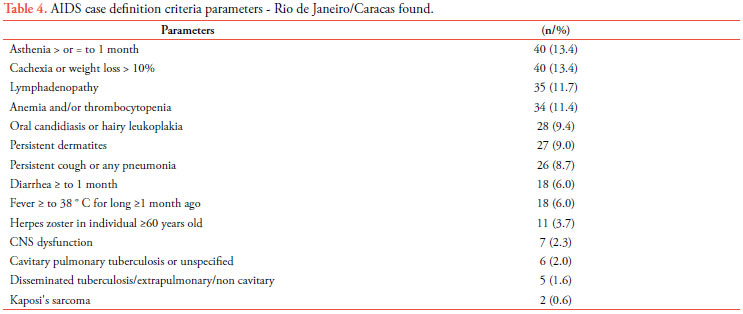
The criteria of the definition of AIDS occurs when the patient receives 10 points or more. Most patients, 47 (52.8%) had between zero and nine points and had not a confirmed diagnosis. Forty-two patients had more than ten points, distributed as follows - 37 (41.5%) people between 10 and 19 points, 4 (4.4%) between 20 and 29 points and one (1.1%) above 30 points - and were diagnosed with AIDS. The mean score on the criteria was 8.5 points.
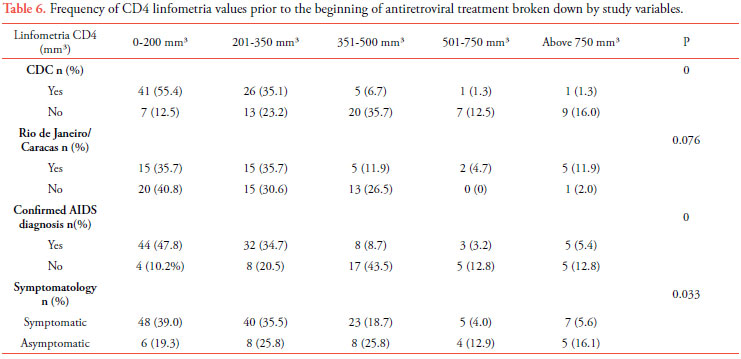
Tables 5 and 6 bring the viral load frequency distributions and CD4 linfometria compared with the frequencies of other five variables: the case definition of AIDS by CDC criteria, case definition of AIDS by Rio de Janeiro/Caracas criteria, confirmed diagnosis of AIDS and symptoms.

DISCUSSION
From a medical point of view, AIDS is a challenge for its spectrum, ranging from an early stage to advanced stage with clinical manifestations increasingly complex and atypical, as it progresses the immune deficiency in the patient. Therefore, the importance of early diagnosis, when CD4 levels are not too low.
The results showed that the epidemiology of HIV in the region resembles with the global scenario of this infection, and especially with the Brazilian scenario. Most of the patients treated were male with a mean age of 38 years and predominance of the white race. These findings were similar to those found in the Report on the global AIDS epidemic/2010 published by the Joint United Nations Programme on HIV/AIDS (UNAIDS)9 and the Epidemiological Bulletin HIV/AIDS published by the Ministry of Health, in 2012,10 which state that in Brazil the trend of infection is prevalent in the male population, white race and the incidence rate for age is considerably higher among 35-39 years.
As to the larger number of male patients, research shows that men seek less health services and do so only when symptomatic, in comparison to women. Hence, the need for prevention campaigns for this public, as the level of education influences in taking preventive measures and better adoption to treatment, once established disease.11
As to the AIDS incidence rate in recent years, it was observed tendency of stabilization, albeit at high levels. Regional differences are observed with decline in incidence rates in the Southeast, according to reports from the Ministry of Health,10 but over the years more patients come seeking the CTA and more patients are being diagnosed. This stabilization is due to universal access increase to specialized services for HIV / AIDS in Brazil, and not to the greater number of cases of infection.
There is a tendency of the AIDS epidemic be higher among subgroups at highest risk. CTA subgroups of sexual risk behavior - homossexuals, bisexuals and multiple partners - and injecting drug users were identified in significant numbers for the region. Furthermore, most patients in this group are male, which according to the literature exposes more to risk behaviors, and uses more of licit or illicit drugs and when such practices interferes with the development of critical judgment, providing unprotected and risky sexual practices.12,13 These data are extremely important, considering that the World Health Organization (WHO)9 stated that modest interventions, in these high-risk groups, can significantly reduce the incidence and prevalence of HIV, reflecting in the general population.
Currently it is discussed about the initial evaluation of CD4 cell count and viral load. In the present study these two laboratory parameters to the first consultation were evaluated to study the early diagnosis of patients seen at CTA. It was found that most participants sought medical care already in considerable stage of immunosuppression. The literature shows that, unfortunately, this is the reality of patients living with HIV / AIDS - the low level of linfometria and high viral load count are consistent with very advanced disease, and thereby, a considerable number of individuals, has disease already installed in primary care.5-8
This information is extremely important, especially because in general, patients with low CD4 cell counts and high viral copies count are infected with HIV for longer time. This demonstrates that patients seek the centers already sick and the service's role is mainly prevention at the secondary level - treatment of HIV infection and opportunistic infections and tumors, limiting disability and sequela.
In addition, stands out the use of educational practices on the importance of HIV testing for individuals at risk in community settings. This role of health services is basic for the early identification of individuals with HIV infection, to reduce transmission to third parties and to improve the prognosis of patients on antiretroviral therapy.
In addition to the immunodeficiency observed laboratorially, most of the patients were enrolled in clinical manifestation, being the most frequent oral candidiasis and herpes zoster - defining symptomatology of AIDS - and classify the patient in the symptomatic phase of HIV infection.
These data primarily demonstrate the importance of the knowledge of the HIV infection primo-symptomatology. Some clinical findings easily diagnosed are good predictors of immunodeficiency progression such as oral candidiasis. Therefore, the clinical evaluation together with the CD4 count and viral load evaluation allows the realization of a more effective diagnosis. Favors the patient, as it enables the delineation of clinical and preventive strategies, allows early identification of the risk of worsening and rapid intervention when the patient seeks care already with advanced disease; scenario increasingly common nowadays.
In general, a correlation is observed between the severity of opportunistic diseases, lymphocytes T CD4 + count and viral load count.14 In the current study, this pattern was observed. The greater the number of viral copies and lower the linfometria, more cases of AIDS are confirmed, according to the international criteria of Rio de Janeiro/Caracas and adapted CDC.
About the beginning of antiretroviral treatment, was observed that most of the study subjects started therapy in the same year they were diagnosed with HIV, which shows the previously seen - patients come to the service already at a stage of deterioration of the immune system and therefore, immediate indication of early antiretroviral treatment. At the CTA, symptomatic patients or with CD4 count <350 células/mm3 were indicated to initiate therapy, according to the recommendations of the Ministry of Health.15
Regarding the presence of clinical situation unrelated to AIDS it was found that depression was the most common condition. Studies indicate that depressive disorders are the most common of the mental disorders among people with HIV/AIDS and are associated with factors such as the discovery of the infection, the beginning of physical symptoms, disease progression and the limitations it imposes, besides the presence of opportunistic infections in the central nervous system and complex psychosocial issues involved.16
This finding is important because the service is concerned with antiretroviral treatment and quantification of laboratory markers. However, depression can hinder adherence to treatment - the discovery of HIV implies revaluation of life. The treatment is rigorous; adhesion and the discipline to take medication are related to the desire to live. Thus, the depression needs to be identified and treated as soon as possible.
Given the problems related to HIV infection, it's possible to highlight the good practice of medicine, at the first consultation: considering the individual, ethics, anamnesis, attention to epidemiological aspects and conducting a careful physical examination. It is added, also, the fact that the prognosis can be determined with relative accuracy using clinical and laboratory data and the defining criteria of AIDS cases. Therefore, professionals, aware and well trained, can set the patient's condition through significant markers in the population routinely treated.
CONCLUSION
This study identified epidemiological and biological characteristics of HIV / AIDS. The results coincide with the data of the Ministry of Health, and the reports of the World Health Organization and thereby reflects the situation of the population.
The problems surrounding AIDS involves not only the fact that the disease display high morbidity and mortality, but also that the main implications stem from the lack of cure for the disease and the high rates of HIV-infected people.
It is essential that both the scientific population, as the laity learns that early diagnosis may contribute to the increase of prevention at primary level - prophylaxis of opportunistic infections and guidelines on prevention of HIV transmission - and secondary - HIV infection treatment and opportunistic infections and tumors, limiting disability and sequela.
Undoubtedly, early diagnosis based on clinical, on linfometria and viral load can improve the prognosis of HIV-infected. Even when installed infection it's possible the control of immune deterioration and the occurrence of opportunistic infections, providing a better prognosis for the patient and an increase the patient's quality of life for living with the disease.
REFERENCES
1. Centers for Disease Control (CDC). Kaposi's sarcoma and Pneumocystis pneumonia among homosexual men--New York City and California. MMWR Morb Mortal Wkly Rep. 1981;30(25):305-8.
2. Wei X, Ghosh SK, Taylor ME, Johnson VA, Emini EA, Deutsch P, et al. Viral dynamics in human immunodeficiency virus type 1 infection. Nature. 1995;373(6510):117-22.
3. Ho DD, Neumann AU, Perelson AS, Chen W, Leonard JM, Markowitz M. Rapid turnover of plasma virions and CD4 lymphocytes in HIV-1 infection. Nature. 1995;373(6510):123-6.
4. Brasil. Ministério da Saúde. O Manejo da Infecçao pelo HIV na atençao Básica. Brasília: Ministério da Saúde; 2015. [cited 2017 Feb 20]. Available from: http://www.aids.gov.br/pt-br/pub/2016/o-manejo-da-infeccao-pelo-hiv-na-atencao-basica-para-profissionais-medicos
5. Brasil. Ministério da Saúde. Protocolo Clínico e Diretrizes Terapêuticas para Adultos Vivendo com HIV/AIDS. Brasília: Ministério da Saúde; 2013. [cited 2017 Feb 20]. Available from: http://bvsms.saude.gov.br/bvs/publicacoes/protocolo_clinico_manejo_hiv_adultos.pdf
6. Neal JJ, Fleming PL. Frequency and predictors of late HIV diagnosis in the United States, 1994 through 1999. In: Proceedings of the 9th Conference on Retroviruses and Opportunistic Infection; 2002 Feb 24-28; Seattle, WA, USA.
7. Sanders GD, Bayoumi AM, Sundaram V, Bilir SP, Neukermans CP, Rydzak CE, et al. Cost-effectiveness of screening for HIV in the era of highly active antiretroviral therapy. N Engl J Med. 2005;352(6):570-85.
8. Dybul M, Bolan R, Condoluci D, Cox-Iyamu R, Redfield R, Hallahan CW, et al. Evaluation of initial CD4+ T cell counts in individuals with newly diagnosed human immunodeficiency virus infection, by sex and race, in urban settings. J Infect Dis. 2002;185(12):1818-21.
9. UNAIDS/WHO. Report on the global HIV/AIDS epidemic. Geneva: UNAIDS; 2010.
10. Brasil. Ministério da Saúde. Boletim Epidemiológico - HIV AIDS. 2012; 1. [cited 2013 Jan 20]. Available from: http://bvsms.saude.gov.br/bvs/periodicos/boletim_epidem_hivaids_2012.pdf
11. Marques Júnior, JR Gomes, Nascimento EF. Masculinidade hegemônica, vulnerabilidade e prevençao ao HIV/AIDS. Ciênc Saúde Coletiva. 2012;17(2):511-20.
12. Amaral ACG, Saldanha AAW. A vulnerabilidade à AIDS associada ao uso de álcool por adolescentes. VII Congresso Virtual HIV/AIDS: O VIH/SIDA nos Países de Língua Portuguesa. [cited 2013 Sep 8]. Available from: http://apps.siquant.pt/aidscongress/Modules/WebC_AidsCongress/CommunicationHTML.aspx?Mid=36&
13. Sousa Júnior AB, Szwarcwald CL, Pascom ARP, Souza Júnior PB. Trends in the AIDS epidemic in groups at highest risk in Brazil, 1980-2004. Cad Saúde Pública. 2009;25(4):727-37.
14. Bartlett JG, Gallant JE, Pham PA. Medical management of HIV infection 2009-2010. 15th ed. Baltimore: Johns Hopkins University Press; 2009.
15. Brasil. Ministério da Saúde. Secretaria de Vigilância em Saúde. Departamento de DST, Aids e Hepatites Virais. Recomendaçoes para terapia antirretroviral em adultos infectados pelo HIV - 2008, Org. Hallal R, Grinsztejn B. Brasília: Ministério da Saúde; 2010. [cited 2013 Dec 8]. Available from: http://www.aids.gov.br/sites/default/files/pub/2007/59204/suplemento_consenso_ adulto_01_24_01_2011_web_pdf_13627.pdf
16. Malbergiera A, Schoffel CA. Tratamento de depressao em indivíduos infectados pelo HIV. Rev Bras Psiquiatr. 2001;23(3):160-