INTRODUCTION
Surgical site demarcation prior to surgery is a method widely used in a range of situations, playing a considerable role in aesthetic procedures, being well discussed in literature the different dyes types, functions and advantages1. Methylene Blue (MB) is a major utilized dye, and its use is well described in rhinoplasty techniques2,3 and other facial procedures.
Although that are some MB ocular related complications described in literature, they are concerning in its totality inadvertent anterior chamber injection in cataract surgery, leading to sterile endophthalmitis, corneal edema and iris discoloration4,5,6. So far, we have not found complications of the contact of MB with the external part of the eye.
The following case reports a rare ocular complication of MB during a rhinoplasty.
To our knowledge, this is the first relevant report highlighting the toxicity of a commonly used dye; it is also a warning to plastic surgeons and otolaryngologists.
CASE REPORT
A woman in her late twenties is submitted to a septorhinoplasty for aesthetic and functional purposes. Lidocaine 2% and epinephrine 0,5% were used for local anesthesia. It was made a conventional septoplasty positioning bilateral auto-spreaders, followed by rhinoplasty and positioning of grafts in dorsal and filling with radix and splint.
In the middle of the surgery, when site demarcation for an external osteotomy was being made with MB, some of the product drained from the patient skin nose to the inferior portion of her left eye. Although Carbomer gel for eye protection was used, when the chief surgeon opened the patient's eye for evaluation, he found focal iris discoloration and diffuse conjunctival hyperemia of approximately 2 mm.
In sequence, the staff made copious local irrigation with a balanced salt solution and proceeded with the surgery. When the anesthesia was over, the patient reported an eye burning sensation. She was promptly referred to ophthalmologic service. Under evaluation it was spotted a chemical burning in the left eye, stained by fluorescein (figure 1), an indicative of corneal abrasion.
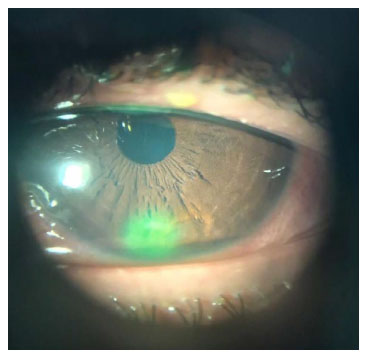
Figure 1. Corneal abrasion stained by fluorescein Diffuse conjunctiva hyperemia, corneal abrasion of approximately 2mm stained by fluorescein.
The test was also positive under blue light (figure 2).
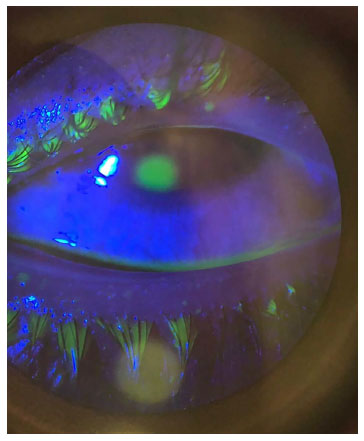
Figure 2. Corneal abrasion under blue light. Corneal abrasion under blue light stained by fluorescein.
It was prescribed a gel with retinyl acetate and an occlusive dressing. In the follow up the patient did not evolve with visual loss, mainly because the abrasion was in the peripheral region of the cornea. Four weeks later after the surgery, the burns showed full regression and no symptoms related.
DISCUSSION
MB is a cheap dye, easily sterilized and widely used in daily practice of many aesthetic facial procedures and, in this case, for demarcation prior to surgery. Yet, it presented with a high toxicity when in contact with the external part of the eye.
The physiopathology of its toxicity is unknown; it may be related to the oxidation-reduction of MB or to its photosensitizing effects resulting in production of oxidizing radicals. In a darker scenario, it could have impaired the patient's vision. No surgical intervention was necessary, and the patient has fully recovered within four weeks.
This kind of complication is rare in literature, but when MB is injected in the anterior chamber or in other eye chemical burns, it is necessary indication of immediate pause of surgery, followed by copious wash with saline to limit the area of MB toxicity, and intensive topical steroids and antibiotics may be needed7,8.
This case underscores the importance of eye protection techniques when surgeries take place in face and peri ocular regions, as in rhinoplasties. An additional caution should be considered when using MB. Further studies are warranted to consider the need of replacement of Methylene Blue in these cases.
REFERENCES
1. Granick MS, Heckler FR, Jones EW. Surgical Skin-Marking Techniques. Plastic and Reconstructive Surgery. 1987;79(4):573-80.
2. Daniel RK, Palhazi P, Gerbault O, Kosins AM. Rhinoplasty: The Lateral Crura-Alar Ring. Aesthetic Surgery Journal. 2014;34(4):526-37.
3. Daniel RK, Schlesinger J., 2013. Rhinoplasty: an atlas of surgical techniques. New York, NY: Springer, pp.62; pp.252.
4. Brouzas D, Droutsas D, Charakidas A, Malias I, Georgiadou E, Apostolopoulos M, et al. Severe Toxic Effect of Methylene Blue 1% on Iris Epithelium and Corneal Endothelium. Cornea. 2006;25(4):470-1.
5. Lim AKE, Ulagantheran V, Siow YC, Lim KS. Methylene Blue Related Sterile Endophthalmitis. Medical Journal of Malaysia. 2008Aug;249-50.
6. Timucin OB, Karadag MF, Aslanci ME, Baykara M. Methylene blue-related corneal edema and iris discoloration. . Arq. Bras. Oftalmol. 2016 Apr ; 79( 2 ): 121-122.
7. Sharma N, Kaur M, Agarwal T, Sangwan VS, Vajpayee RB. Treatment of acute ocular chemical burns. Survey of Ophthalmology. 2018;63(2):214-35.
8. Wipperman Jenniferl, Dorsch Johnn. Evaluation and management of corneal abrasions. American Family Physician. 2013Jan15;87.